
Data
590,000 Houston-Area Homes Have No Homestead Exemption on File
The number: 590,914 homes in the five-county Houston metro have no homestead exemption on file. That is roughly three in ten homes, and in the lowest-value neighborhoods it is closer to one in two. We found it by analyzing every residential account in the Harris, Fort Bend, Montgomery, Brazoria, and Galveston county appraisal rolls, part of a 3.6 million-record dataset we maintain across nine Texas counties.
Not all of those homes are eligible. Rentals, second homes, and houses bought within the last few months cannot claim the exemption. But the shape of the data, which we lay out below, is not what a rentals-only explanation would produce. Coverage falls steadily as home values fall and as you move into the city's historically underserved ZIP codes, exactly where a $1,000-plus annual tax break matters most.
What the homestead exemption is worth in 2026
The Texas residence homestead exemption removes part of your home's value from taxation and caps how fast your taxable value can rise. For the 2026 tax year, after voters approved Proposition 13 in November 2025:
- $140,000 of appraised value is exempt from school district taxes (up from $100,000)
- An additional $60,000 is exempt for homeowners age 65 or older or disabled (up from $10,000)
- Counties, cities, and special districts can add their own local-option exemptions, commonly 20% of value in Harris County
- Your taxable value cannot rise more than 10% per year while the exemption is in place
In practical terms, a Houston-area homeowner with a school tax rate around $1.00 per $100 of value saves about $1,400 a year from the school exemption alone before any local-option savings. The homestead filings our own clients have completed have each saved more than $1,000 per year, with refunds reaching back to 2024 in cases where the exemption was never claimed. Our Texas homestead exemption guide walks through the rules and the filing steps.
There is no fee to file, and no deadline that ends your eligibility: Texas Tax Code Section 11.431 allows late applications up to two years after the delinquency date, with a refund of the overpaid tax.
The metro-wide picture
Across the nine counties in our dataset (the Houston, Austin, and Dallas-Fort Worth metros), 1,119,257 homes appraised at $50,000 or more have no homestead exemption on file. The Houston metro accounts for 590,914 of them.
| County | Homes analyzed | Homestead coverage | Homes with no exemption | Median appraised value |
|---|---|---|---|---|
| Harris | 1,171,631 | 71.1% | 338,250 | $275,796 |
| Dallas | 621,647 | 65.4% | 215,028 | $315,110 |
| Collin | 386,200 | 67.6% | 125,283 | $462,747 |
| Travis | 374,519 | 66.4% | 125,763 | $447,830 |
| Fort Bend | 290,495 | 73.0% | 78,550 | $382,500 |
| Montgomery | 250,945 | 66.7% | 83,590 | $319,517 |
| Williamson | 232,969 | 73.3% | 62,296 | $399,907 |
| Galveston | 135,055 | 63.9% | 48,741 | $317,964 |
| Brazoria | 134,135 | 68.9% | 41,756 | $312,830 |
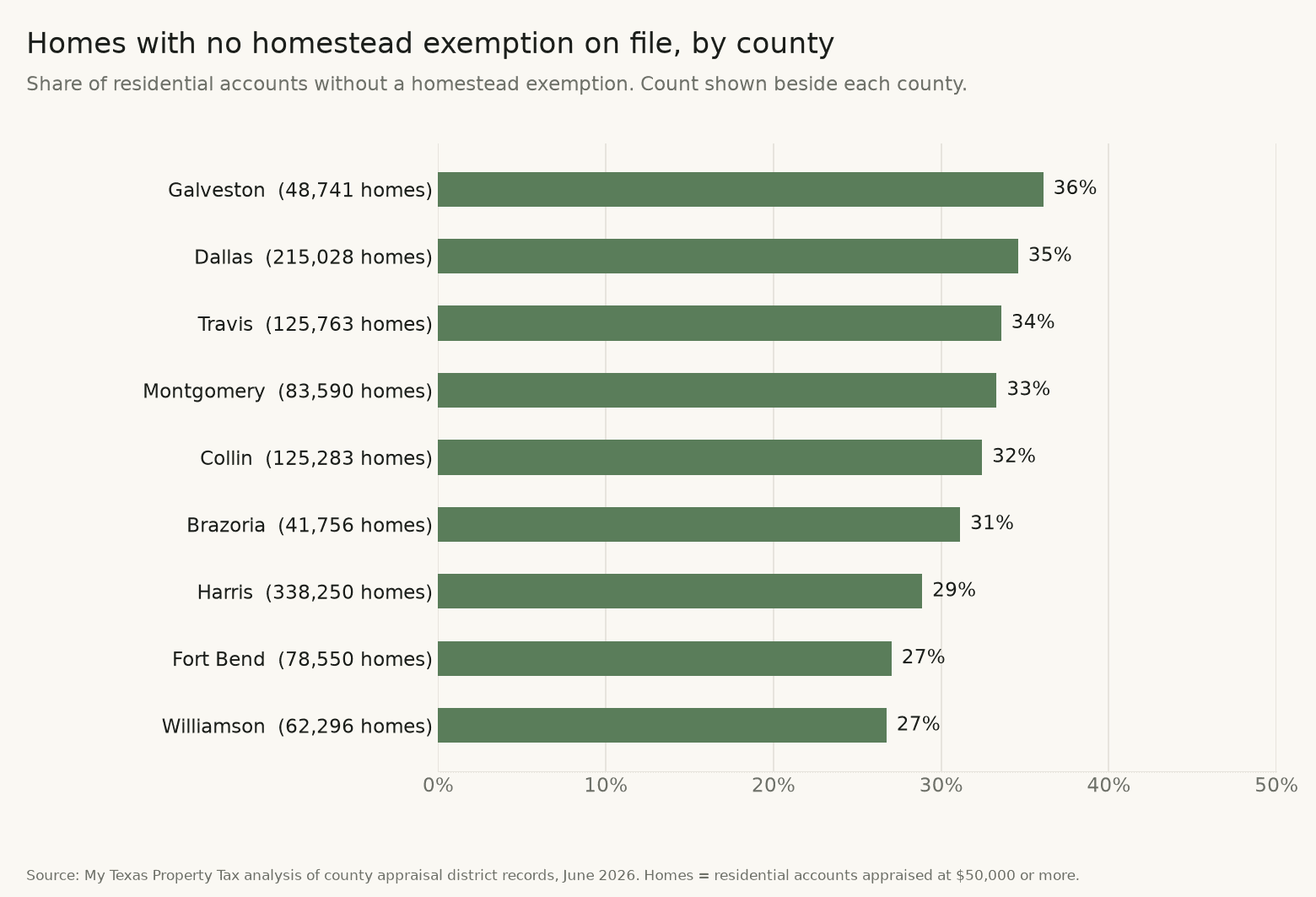
Galveston County's low coverage (63.9%) is partly explained by its share of beach and bay second homes, which are legitimately ineligible. Fort Bend and Williamson, dominated by owner-occupied suburban subdivisions, sit at the top. Harris County, with the largest and most varied housing stock in Texas, lands in the middle at 71.1%, and it is the county where the neighborhood-level pattern is most revealing.
The gap tracks home value
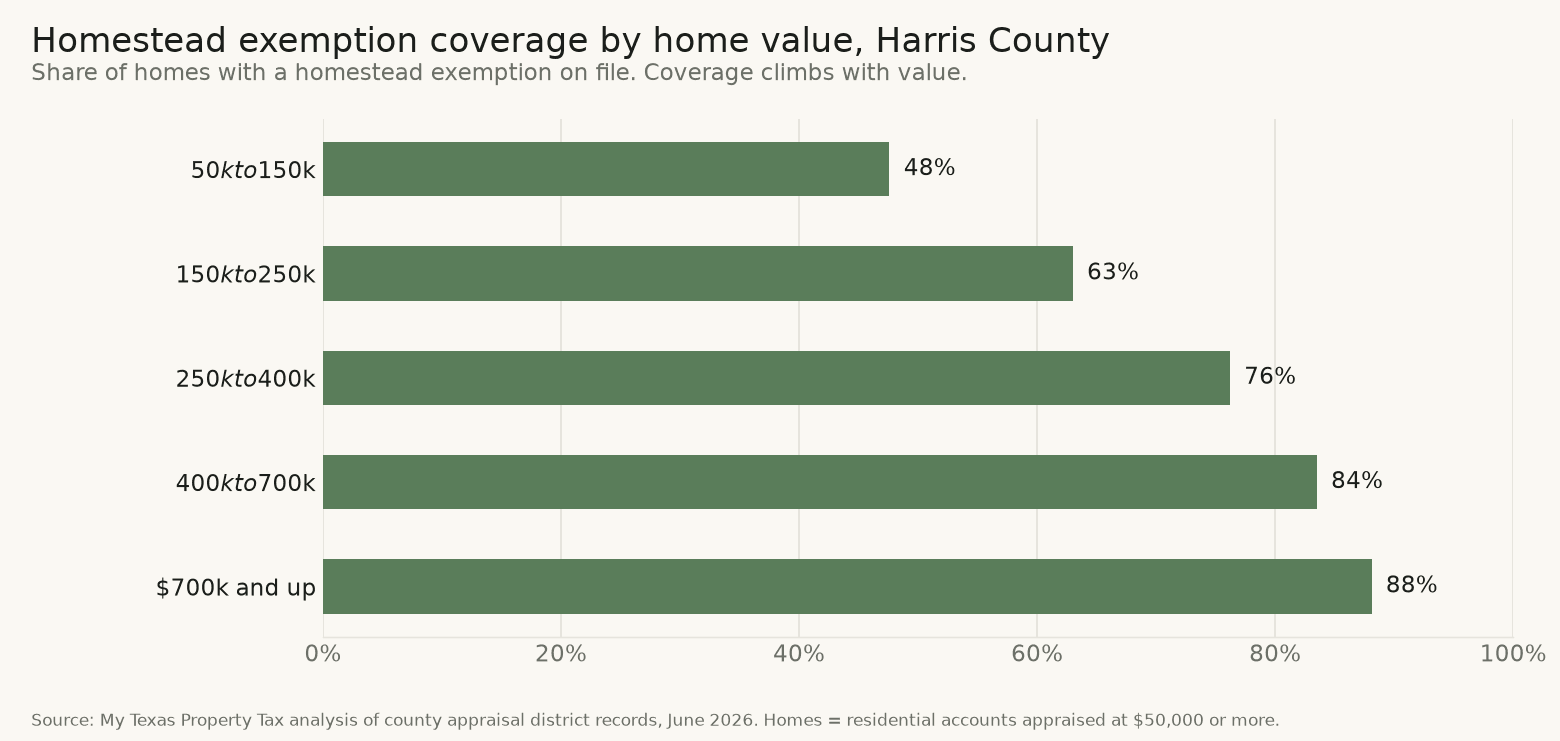
We grouped Harris County homes into five appraised-value bands. Homestead coverage climbs in a straight line with value:
| Appraised value | Homes | Homestead coverage |
|---|---|---|
| $50,000 to $150,000 | 125,066 | 47.6% |
| $150,000 to $250,000 | 352,942 | 63.0% |
| $250,000 to $400,000 | 426,533 | 76.2% |
| $400,000 to $700,000 | 183,255 | 83.5% |
| $700,000 and up | 83,774 | 88.1% |
Homes worth more than $700,000 are almost twice as likely to carry a homestead exemption as homes worth less than $150,000. Some of that difference is ownership: lower-value homes are more often rentals. But the exemption is proportionally worth far more on a cheap house. A $140,000 school exemption on a $130,000 home removes the entire school tax bill. On a $1.6 million home it trims less than a tenth of it. The households with the most to gain, as a share of what they pay, are the least likely to have filed.
The ten Harris County ZIP codes with the lowest coverage
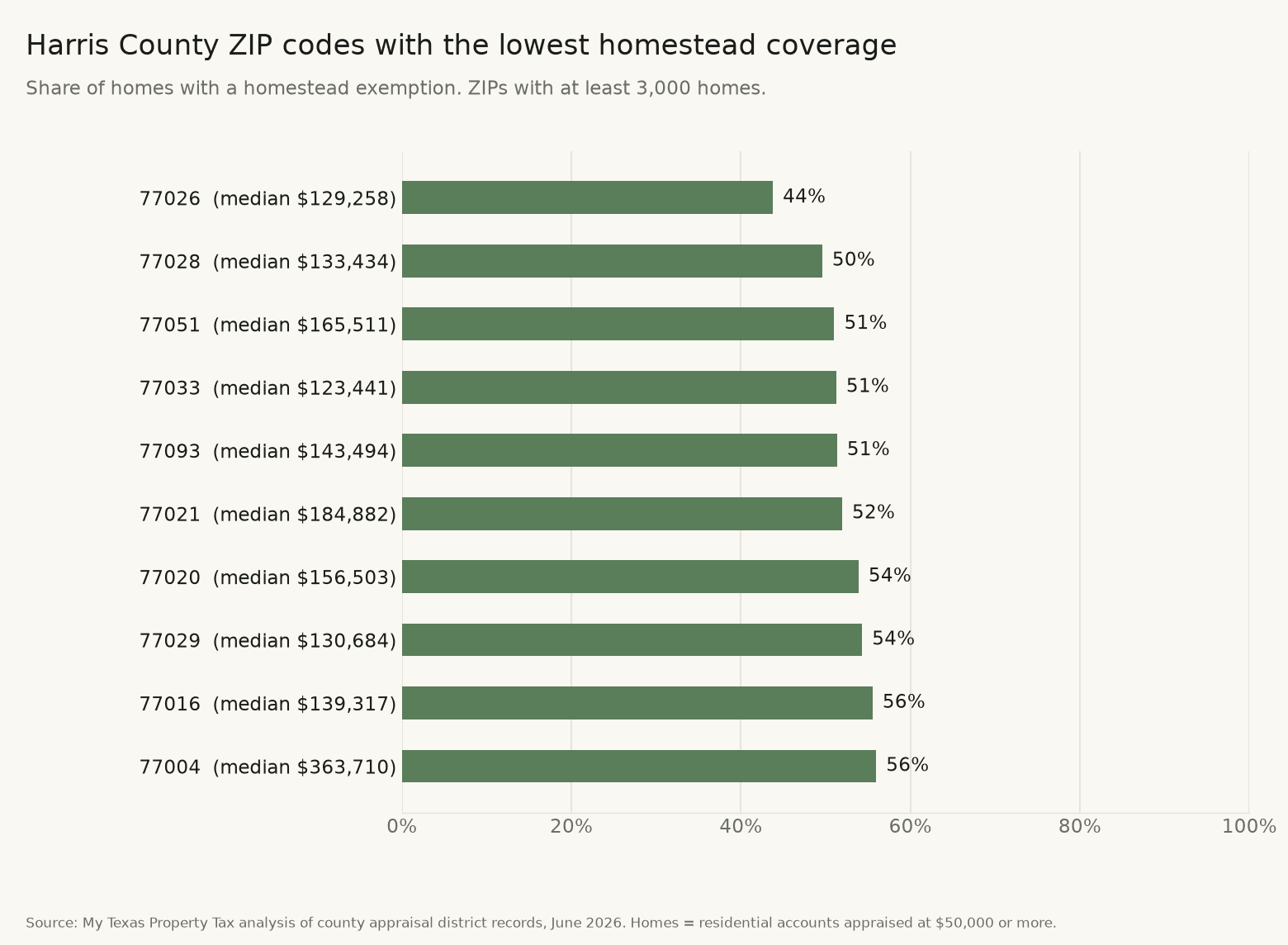
Limiting the view to ZIP codes with at least 3,000 homes, here is where homestead coverage is thinnest:
| ZIP | Area | Homes | Homestead coverage | Median appraised value |
|---|---|---|---|---|
| 77026 | Fifth Ward / Kashmere Gardens | 6,372 | 43.8% | $129,258 |
| 77028 | Trinity Gardens / Northeast Houston | 6,355 | 49.6% | $133,434 |
| 77051 | Sunnyside | 5,386 | 51.0% | $165,511 |
| 77033 | South Park | 8,848 | 51.2% | $123,441 |
| 77093 | Northside / Aldine area | 10,172 | 51.3% | $143,494 |
| 77021 | OST / South Union | 7,548 | 51.9% | $184,882 |
| 77020 | Fifth Ward / Denver Harbor | 7,174 | 53.9% | $156,503 |
| 77029 | Pleasantville / Jacinto City area | 5,313 | 54.3% | $130,684 |
| 77016 | Scenic Woods / Trinity Gardens | 10,257 | 55.5% | $139,317 |
| 77004 | Third Ward / Museum District | 6,991 | 55.9% | $363,710 |
At the other end, coverage tops 85% in 77059 (Clear Lake, 90.0%), 77094 (west Energy Corridor, 88.5%), 77024 (Memorial, 87.8%), 77345 (Kingwood, 87.4%), 77079 (86.5%), 77401 (Bellaire, 86.4%), 77005 (West University, 86.4%), and 77505 (Pasadena, 85.8%).
In 77026, fewer than half of homes carry the exemption. The median home there is appraised at about $129,000, which means a homeowner who files gets the school portion of their bill reduced to nearly nothing. Even if only one in five of the roughly 3,600 non-homestead homes in that ZIP belongs to an eligible owner-occupant, that is more than 700 households leaving a four-figure tax break unclaimed every year.
Three reasons the exemption gets missed
- The purchase moment. Title companies often hand new buyers a homestead form at closing, but nothing follows up. If the form is not filed with the appraisal district, the previous owner's exemption quietly drops off the next year and the bill goes up.
- Inherited and informally transferred homes. When a home passes to children or relatives, especially without probate, the exemption on record belongs to a deceased owner and eventually ends. Texas allows heir-property owners to claim the exemption, but they have to file. Our guide to capital gains tax on inherited property covers the federal side; the homestead filing is the local side.
- Confusing notices. Appraisal notices list exemptions in a small section most people never read. If a homeowner does not know what should be there, they cannot notice what is missing.
How to check your home in two minutes
- Search your address on your county appraisal district's site: HCAD, FBCAD, MCAD, BCAD, or GCAD.
- Open your property record and find the exemptions section.
- If it does not show a residence homestead exemption and the home is your primary residence, download Form 50-114 from the Texas Comptroller, attach a copy of your Texas driver's license showing the property address, and file it with the appraisal district. There is no fee.
- If you have owned and lived in the home for more than a year without the exemption, ask for the late application to cover the prior two years as well. The refund arrives from the tax office.
If you would rather not deal with it, we file homestead exemptions for our protest clients as part of the service, including the back-filing.
Methodology
We analyzed county appraisal district records for nine Texas counties as of June 2026: Harris, Fort Bend, Montgomery, Brazoria, Galveston, Travis, Williamson, Dallas, and Collin, a total of 4.9 million accounts. "Homes" are accounts the appraisal district classifies as residential, with an appraised value of at least $50,000; the value floor removes vacant lots and accounts with placeholder values. "Homestead coverage" is the share of those homes with a residence homestead exemption code on the appraisal roll. ZIP-level figures include only ZIP codes with at least 3,000 qualifying homes. Neighborhood names are approximate descriptions of each ZIP code's best-known areas. Appraisal records do not indicate owner-occupancy, so these figures measure exemptions on file, not eligibility.
This article is general information, not tax advice. Exemption eligibility depends on your specific circumstances; confirm with your county appraisal district.
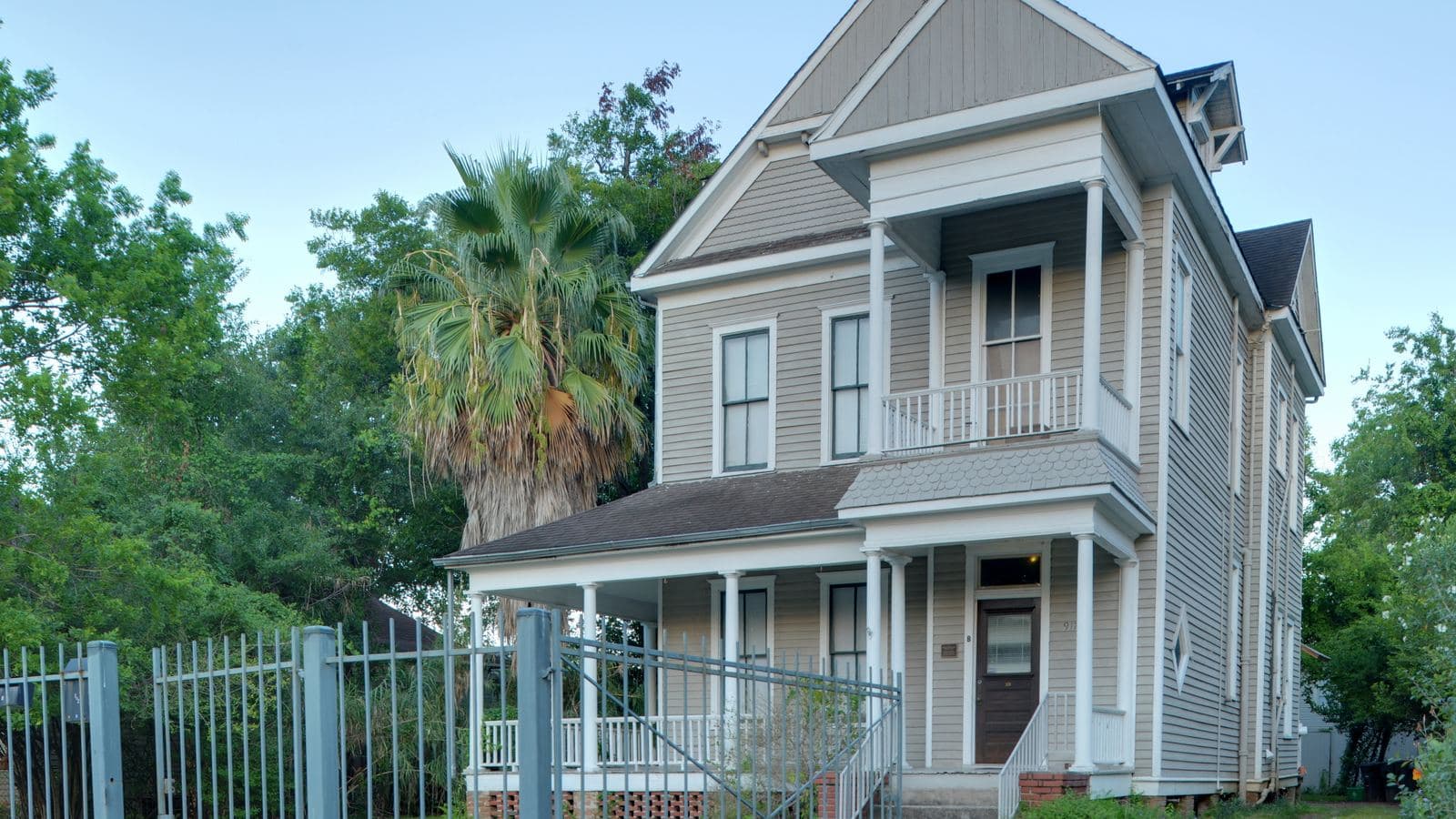
Photo: 917 Heights Boulevard, Houston by Ed Uthman via Wikimedia Commons, CC BY 3.0, cropped.